As UAE organizations accelerate digital transformation, cloud adoption, and online services, cybersecurity risks continue to increase. A single vulnerability in a network, application, API, or cloud environment can lead to data breaches, financial loss, operational disruption, and regulatory non-compliance.
Vulnerability Assessment and Penetration Testing (VAPT) helps organizations identify and validate security weaknesses before attackers can exploit them.
For many UAE organizations, VAPT is more than a cybersecurity best practice. Depending on the sector, it may also form part of regulatory, contractual, or compliance requirements.
Increasingly, regulators and auditors expect organizations to demonstrate not only that security testing has been performed, but also that identified vulnerabilities have been risk-assessed, remediated, retested and formally closed.
MAST Consulting provides VAPT services across the UAE, the Middle East, and other parts of the world, helping organizations identify vulnerabilities, prioritize remediation, and strengthen compliance with applicable cybersecurity requirements.
What is VAPT?
VAPT combines two complementary security-testing activities:
Vulnerability Assessment (VA) identifies known security weaknesses, outdated software, insecure configurations and exposed services.
Penetration Testing (PT) safely simulates real-world cyberattacks to determine whether vulnerabilities can be exploited and understand their potential business impact.
VAPT can cover:
- Internal and external networks
- Web applications
- Mobile applications
- APIs
- Servers and endpoints
- Cloud infrastructure
- Internet-facing assets
- Wireless infrastructure
- Thick-client applications, where applicable
- Configuration/security posture assessments
Is VAPT Mandatory in the UAE?
There is no single UAE regulation requiring every company to perform annual VAPT. Requirements depend on the organization’s sector, regulator, systems, contractual obligations, and risk profile.
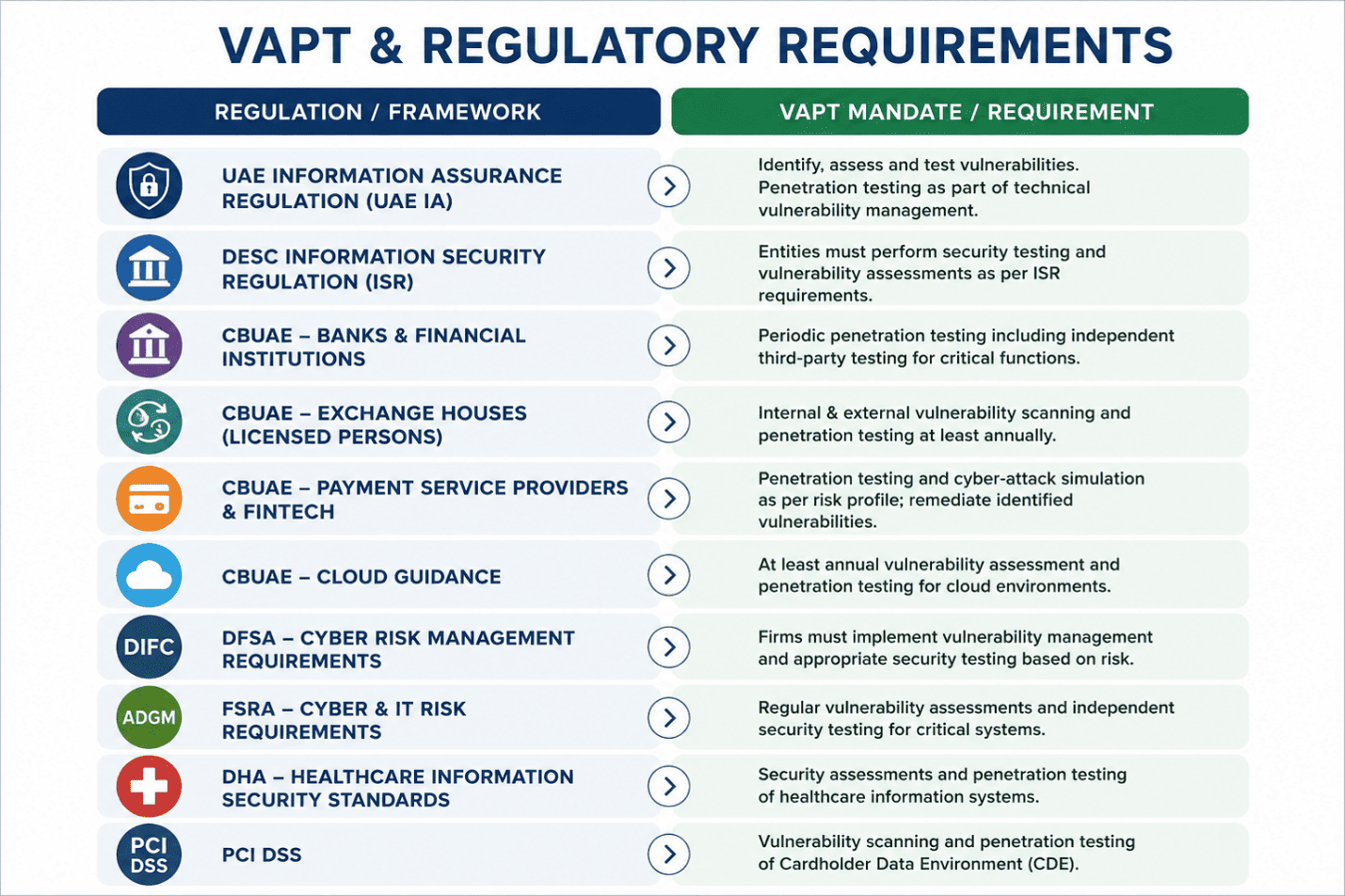
However, several UAE regulatory frameworks include requirements or expectations relating to vulnerability assessment, penetration testing and security testing.
UAE Information Assurance Regulation
The UAE Information Assurance Regulation (UAE IA) includes technical vulnerability management requirements. Regulated entities are expected to identify vulnerabilities, assess exposure, and implement appropriate remediation and verification measures.
Vulnerability assessment and penetration testing can provide important evidence for demonstrating implementation of these controls.
DESC Information Security Regulation
Dubai Government Entities subject to the Dubai Electronic Security Center (DESC) Information Security Regulation – ISR must implement cybersecurity controls covering technical vulnerabilities and security testing.
Organizations should also consider DESC requirements relating to approved or certified cybersecurity service providers when penetration testing involves Dubai Government environments.
CBUAE – Banks & Financial Institutions
For organizations regulated by the Central Bank of the UAE (CBUAE), cybersecurity and technology-risk requirements can include vulnerability assessments, penetration testing, independent security testing and remediation.
Certain CBUAE requirements specifically require independent third-party penetration testing for critical functions.
Exchange Houses
VAPT requirements are particularly clear for applicable Licensed Persons.
CBUAE Rulebook requirement 14.9.1 requires internal and external vulnerability scanning and penetration testing of networks and systems at least annually, together with appropriate mitigation of identified issues.
Payment & FinTech Organizations
Payment Service Providers and other applicable CBUAE-regulated entities must maintain technology-risk and information-security controls.
Depending on the applicable requirements and risk profile, this can include penetration testing, cyberattack simulation, vulnerability assessment and remediation tracking.
Cloud Environments
CBUAE guidance for financial institutions adopting enabling technologies addresses vulnerability assessment and penetration testing for cloud-computing environments, including at least annual VAPT for relevant cloud arrangements.
DIFC / DFSA
Financial institutions regulated by the Dubai Financial Services Authority (DFSA) are subject to Cyber Risk Management requirements.
Vulnerability management and appropriate security testing should form part of the organization’s cyber-risk program based on its nature, scale, complexity and risk exposure.
ADGM / FSRA
Organizations regulated by the ADGM Financial Services Regulatory Authority (FSRA) should consider applicable cyber and technology-risk requirements. FSRA guidance supports vulnerability assessment and appropriate independent security testing, particularly for critical digital environments.
Healthcare
Healthcare organizations should consider applicable DHA, ADHICS and other UAE healthcare cybersecurity requirements. Healthcare information-security standards include requirements relating to security assessments and penetration testing of relevant healthcare information systems.
PCI DSS
Organizations that store, process or transmit payment-card information may also be subject to PCI DSS requirements.
PCI DSS includes requirements covering vulnerability scanning and penetration testing of the Cardholder Data Environment (CDE).
VAPT and ISO/IEC 27001:2022
ISO/IEC 27001:2022 also supports a structured approach to technical vulnerability management.
Relevant controls include:
- A.8.8 – Management of Technical Vulnerabilities
- A.8.9 – Configuration Management
- A.8.20 – Network Security
- A.8.25 – Secure Development Life Cycle
- A.8.29 – Security Testing in Development and Acceptance
ISO 27001 does not automatically require every organisation to conduct annual penetration testing. The frequency and scope should be determined based on risk, regulatory requirements, technology changes and contractual obligations.
When Should VAPT Be Conducted?
Organizations should consider VAPT:
- Annually where required by regulation or contract
- Before launching critical applications
- After significant infrastructure changes
- Following cloud migrations
- After major security incidents
- Before deploying high-risk internet-facing systems
- When required by customers, regulators or certification programmes
MAST Consulting VAPT Services
MAST Consulting provides comprehensive Vulnerability Assessment and Penetration Testing services in Dubai, Abu Dhabi and across the UAE.
Our services include:
- Network VAPT – Internal and external infrastructure security testing.
- Web Application Penetration Testing – Identification of application vulnerabilities, authentication weaknesses and access-control issues.
- Mobile Application Security Testing – Security assessment of Android and iOS applications.
- API Security Testing – Assessment of APIs for authentication, authorisation, data exposure and business-logic vulnerabilities.
- Cloud Security Assessment – Security assessment of cloud infrastructure, configurations and internet-facing services.
What You Receive
A typical MAST Consulting VAPT engagement includes:
- Executive summary
- Detailed technical VAPT report
- Vulnerability severity and risk ratings
- Technical evidence
- Business impact
- Remediation recommendations
- Compliance mapping where applicable
- Remediation tracker
- Retesting and closure verification
VAPT with a Compliance-Focused Approach
MAST Consulting combines technical security testing with cybersecurity governance, risk and compliance expertise.
Our VAPT engagements can be aligned with applicable frameworks including:
UAE IA | DESC ISR | CBUAE | DFSA | ADGM FSRA | DHA | ISO/IEC 27001 | PCI DSS | OWASP
This enables organizations to move beyond simply identifying vulnerabilities:
Identify → Validate → Prioritise → Remediate → Retest → Demonstrate Compliance
Why MAST Consulting?
Our approach helps organizations understand not only what vulnerabilities exist, but also:
- What is the business impact?
- Which vulnerabilities should be prioritized?
- Which regulatory requirements apply?
- How should vulnerabilities be remediated?
- What evidence should be maintained for audits and regulators?
This makes our VAPT services particularly suitable for banks, financial institutions, exchange houses, FinTech companies, government entities, healthcare organizations, and other UAE businesses.
Looking for VAPT Services in UAE?
Don’t wait for attackers to discover your security weaknesses.
MAST Consulting helps organizations identify vulnerabilities, reduce cyber risk and meet applicable UAE cybersecurity and compliance requirements.
Contact MAST Consulting today to discuss your VAPT requirements in Dubai, Abu Dhabi or anywhere across the UAE.